Assertion Evidence Approach
The key ideas behind assertion-evidence are to:
1. Build your talks on messages, not topics
意思是:汇报不是按“话题”堆材料,而是按“你想让观众记住的信息”来组织。
普通做法:
Method
Results
Background
这种标题只是 topic,信息量很低。
更好的做法:
Our method reduces annotation cost by using reports as supervision
Model performance improves most on rare diseases
CT scans provide 3D anatomical information from X-ray projections
这种标题本身就是一个 message,观众看标题就知道这一页的核心结论。
2. Support messages with visual evidence, not long text
** It is important to carefully choose visuals that support the message and avoid those that might be distracting or irrelevant. **
有了 message 之后,slide 正文不要放大段文字,而要放能支撑这个 message 的视觉证据,比如:
- 图像
- 流程图
- 实验结果图
- 对比图
- 简化表格
- 模型结构图
- 高亮后的关键区域
例如你的标题是:
CheXzero learns from radiology reports without manual labels
那么正文最好放一个训练流程图:
X-ray image + report → model training → pathology prediction
而不是写一大段解释模型怎么训练。
slide 的作用不是替你写讲稿,而是给观众一个“视觉锚点”。
3. Explain this evidence by fashioning words on the spot
这句话的意思是:具体解释由演讲者现场说,而不是全部写在 slide 上。
也就是说,slide 上只放:
- 核心结论
- 支撑结论的图
- 少量关键词
然后你现场解释:
这张图左边是输入数据,中间是训练过程,右边是模型如何根据 positive prompt 和 negative prompt 输出 disease probability。
这样观众的注意力在你身上,而不是低头读满屏文字。
Example里面的script 对应的是good slide的script
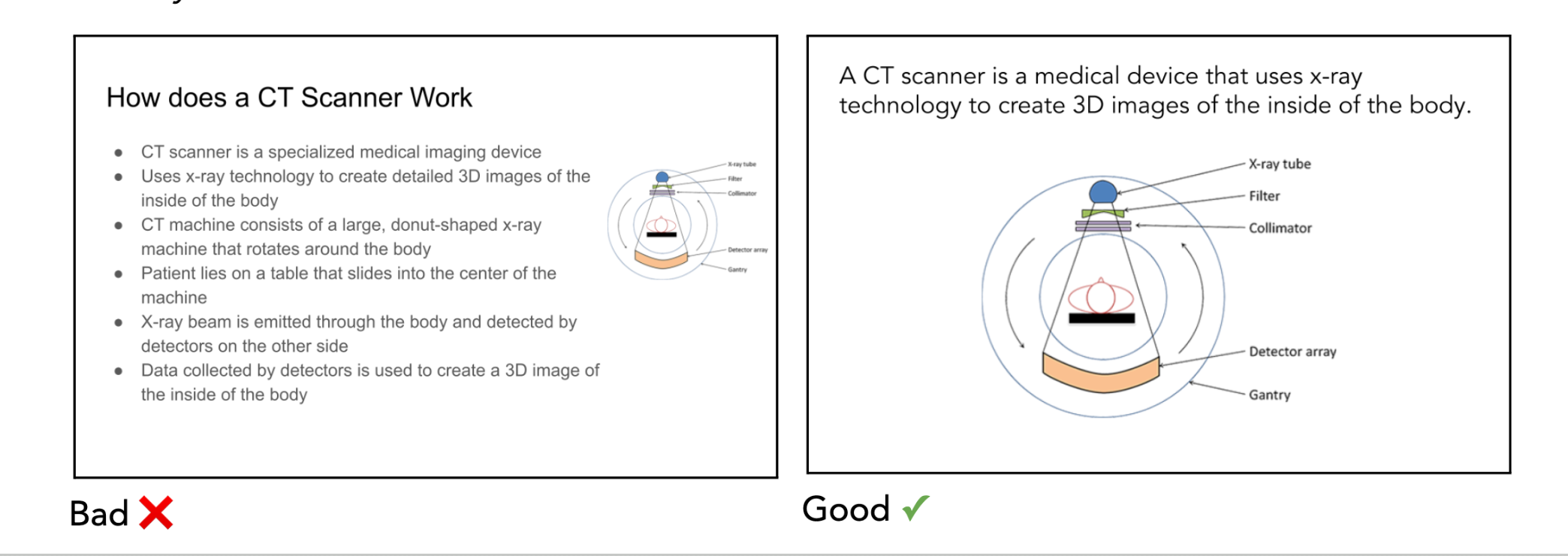
Example 1
Script: “A CT (computed tomography) scanner is a specialized medical imaging device that uses x-ray technology to create detailed 3D images of the inside of the body. The CT machine consists of a large, donut-shaped x-ray machine that rotates around the body while the patient lies on a table that slides into the center of the machine. As the machine rotates, it emits a beam of x-rays through the body, which is then detected by detectors on the other side of the body. The data collected by the detectors is then used to create a 3D image of the inside of the body.”
Example 2
Script: “First, the CheXzero training pipeline involves using raw radiology reports as a natural source of supervision, allowing the model to learn features from them. Then, to predict pathologies in a chest X-ray image, we generated a positive and negative prompt for each pathology, such as 'consolidation' versus 'no consolidation’. By comparing the model output for the positive and negative prompts, the self-supervised method can compute a probability score for the pathology, which can then be used to classify its presence in the chest X-ray image.” 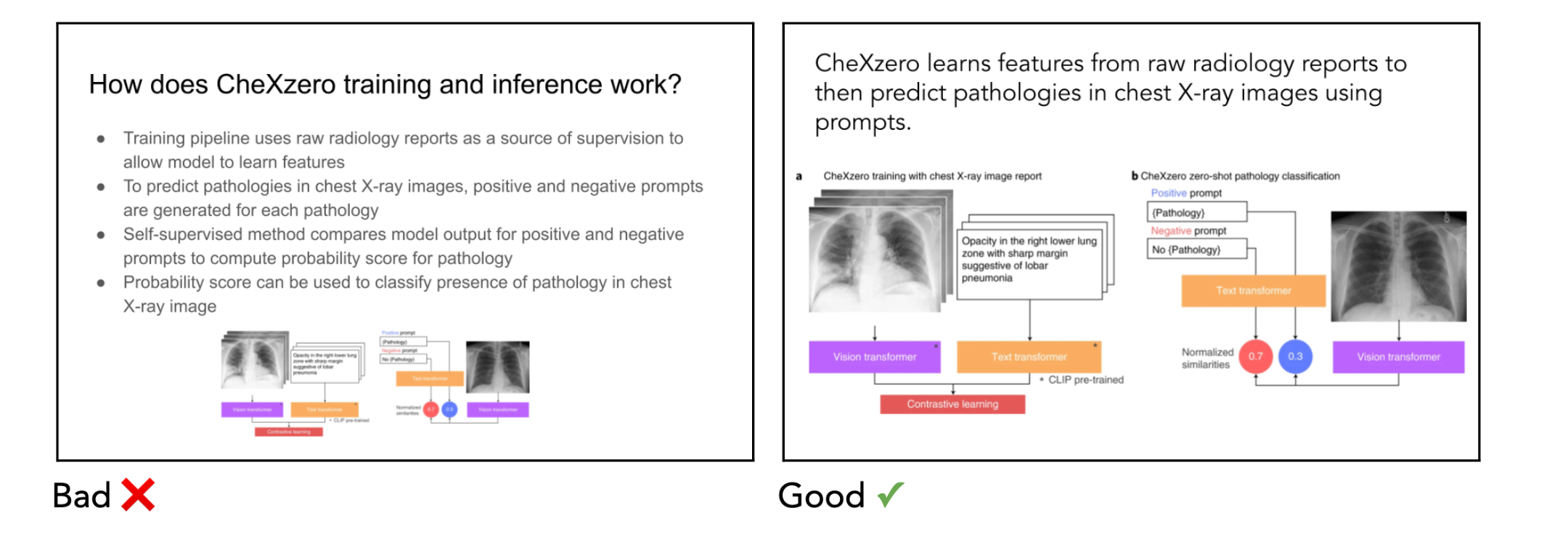
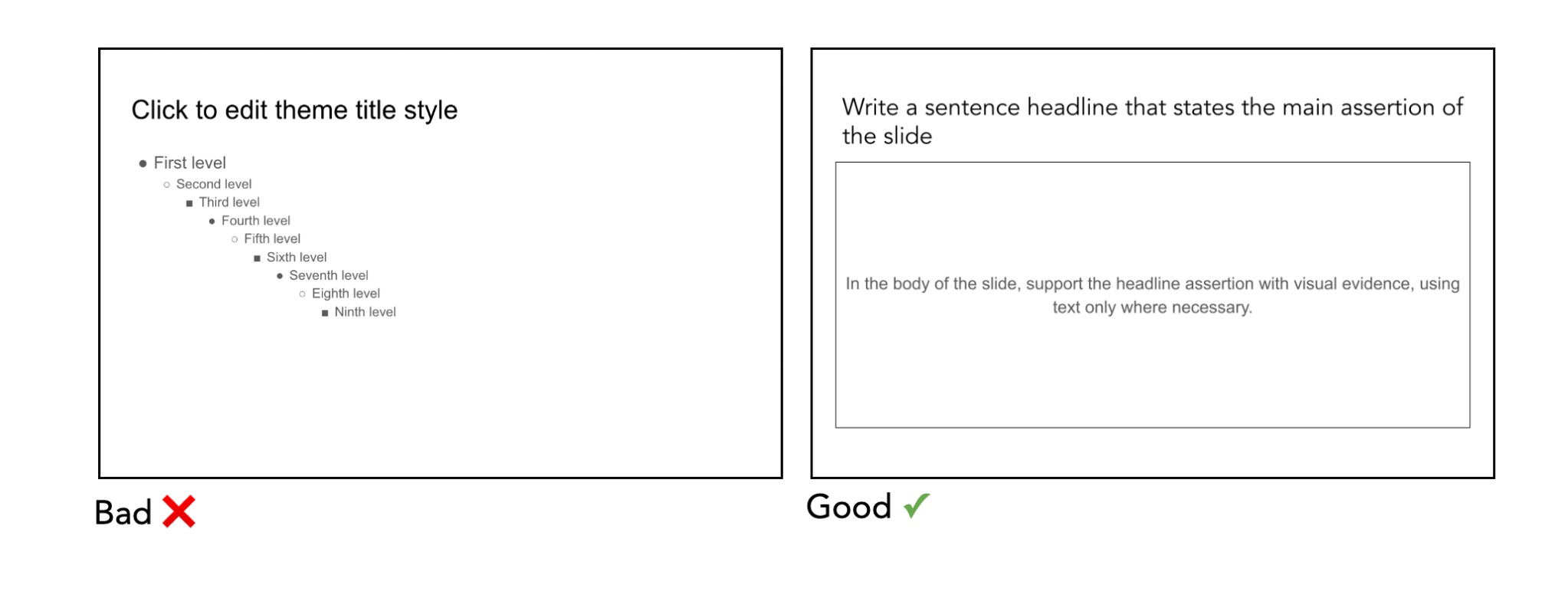
Default Difference
Make Texts Telegraphic
核心思想:
Slides 上的文字应尽量简短,像“电报”一样只保留关键信息,避免完整长句和大段文字。
写法原则
- 用短语,不用完整句子
- 只保留关键词
- 省略可由上下文推断的信息
- 文字用于辅助视觉证据,而不是替代讲解
- 保持简短,但不能含糊
示例
差:
The model is trained on raw radiology reports, which provide a natural source of supervision without requiring manual labels.
好:
Raw reports as supervision
No manual labels
Takeaway
Slide 文字不是论文正文,而是提示词。
少写文字,把详细解释留给演讲者。
Introduce Texts Sequentially
同一页slide的不同要点文字用动画的形式一步步展示,不要一次性全部展示出来 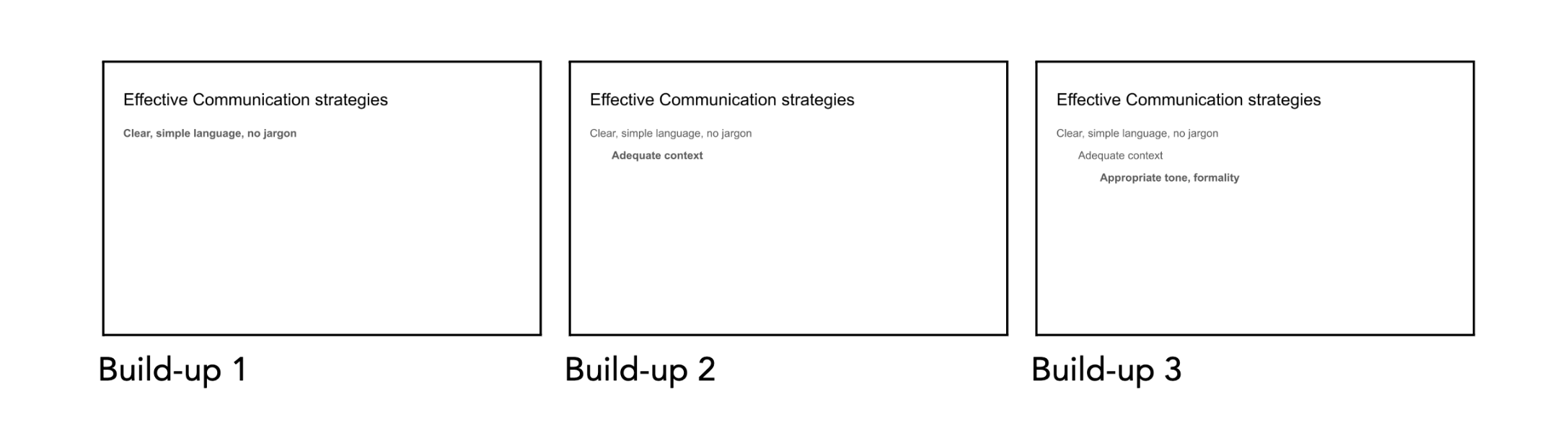
slide 文字与版式的小技巧
1. Serif 和 Sans-serif 字体搭配使用
Serif font 是有衬线字体,比如 Times New Roman,字母笔画末端有小装饰。
Sans-serif font 是无衬线字体,比如 Arial、Helvetica,字形更简洁现代。
常见用法:
- 标题:sans-serif,简洁、醒目
- 正文/说明:serif 或较轻的 sans-serif
- 重点:用字体粗细或颜色区分
Serif fonts are typically used for body text because they are easier to read in large blocks of text due to the extra details on the letters. Sans-serif fonts are often used for headings and other large blocks of text because they are simpler and more modern-looking.
重点是:一套 slides 内保持统一。不要每页换字体,也不要混用太多字体。
2. 使用白色背景
白色背景适合学术 slides,原因主要有三个:
第一,可读性强。
深色文字放在白底上,对比明显,远处也容易看清。
第二,显得专业。
白底比较中性,不会抢内容的注意力。
第三,保持简洁。
复杂背景容易干扰图表、文字和实验结果。
所以除非有特殊设计需求,学术汇报一般优先选择白色或接近白色的背景。
3. 文字颜色控制在两种左右
slides 上不要用太多颜色。颜色太多会让观众不知道哪里是重点。
推荐做法:
-
黑色/深灰:普通文字
-
一种强调色:关键词、重要数字、重点结论
例如:
Baseline accuracy: 72%
Our model: 86%
这里可以只把 86% 或 improvement 用强调色突出。
颜色的作用是建立层级,而不是装饰页面。
4. Footer 放引用和页码
slide 底部可以放两个东西:
引用 citation
如果用了论文、数据集、图表或别人的方法,要在 footer 里标注来源。
这样做有两个好处:
-
显得严谨可信
-
避免来源不清
例如:
Rajpurkar et al., 2022
NIH ChestX-ray14 dataset
页码 page number
页码方便听众提问时定位:
我想问第 12 页那个结果……
也方便你自己控制进度和跳转。
在 presentation 开头放一页 outline slide(大纲页)。
核心目的:先告诉听众这场汇报的结构,让他们知道接下来会听到什么,以及各部分之间是什么关系。
1. Outline slide
比如研究汇报可以这样组织:
## Outline
1. Motivation
2. Method
3. Experiments
4. Results
5. Discussion
更好的版本可以写得更有信息量:
## Outline
1. Why label-efficient medical AI matters
2. How reports provide natural supervision
3. Experiments on chest X-ray classification
4. Key findings and limitations
3. 使用建议
Outline slide 不要写得太细。
一般 3–5 个部分最合适。
不要这样:
1. Background
2. Related Work
3. Dataset
4. Preprocessing
5. Model
6. Training
7. Evaluation
8. Results
9. Ablation
10. Conclusion
太多条会让听众记不住。
更好的是合并成高层结构:
1. Problem and motivation
2. Method overview
3. Experimental evidence
4. Takeaways
Exercise 1
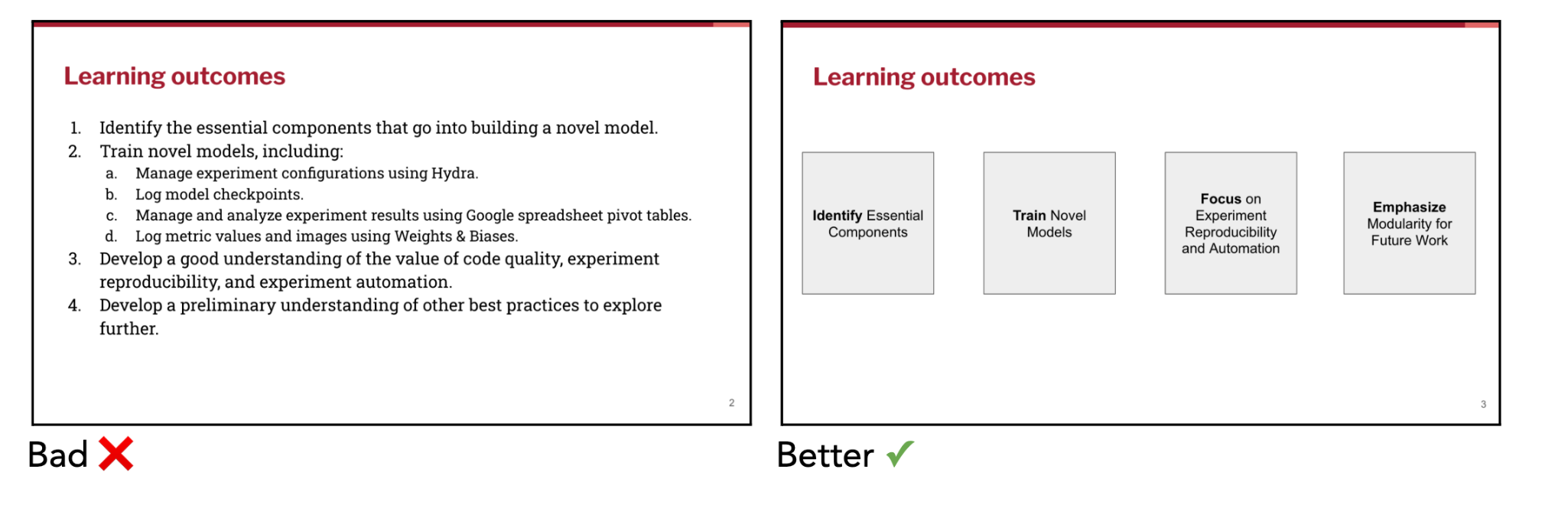
Reasoning:
- Eliminated unnecessary points that can be iterated on by the speaker
- Created object representations of each concept with the key word bolded with the main idea
Exercise 2
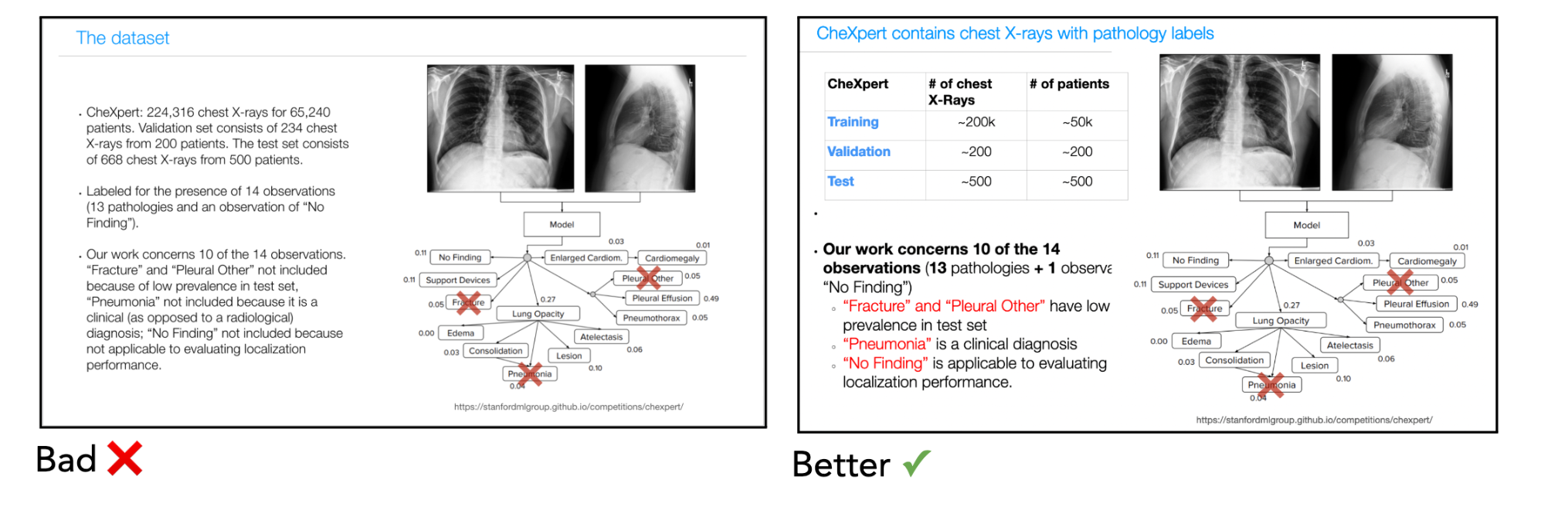
Reasoning:
- More descriptive title
- Less text
- Essential components extracted from figure with color
- Kept only orders of magnitude from the table